Camlo
The Vampire Prince’s BrideCamlo is King Iosif’s heir, but the book presents him chiefly through the political and military shock created by his death. His assassination inside the palace turns an already unstable struggle with the Rebeluna into a crisis of royal security, succession, and responsibility. Although Camlo receives little direct characterization, his position makes him consequential: as the king’s designated successor, he is the person whose removal changes the future of the vampire kingdom and clears the path for Darius’s eventual elevation.
Identity and Position
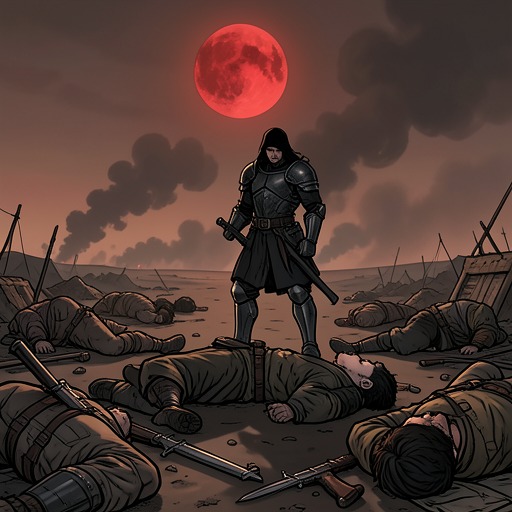
Camlo’s defining identity is his status as King Iosif’s heir. He belongs to the royal succession rather than to the military chain of command, yet his death immediately becomes a matter for Darius and Gordon because it exposes the kingdom’s vulnerability at its center. The assassination is not described as a distant battlefield loss. A cheetah shifter breaks into the palace and kills him, demonstrating that the walls, guards, and courtly protections surrounding the heir are inadequate.
Camlo’s importance therefore rests on the contrast between ceremonial security and actual defenselessness. The palace should have been the safest place in the kingdom, but the killer reaches it during a wider emergency. Lord Virgil’s estates have come under a full-scale attack, and the king has sent troops to reinforce them. With those forces drawn away, the cheetah shifter is caught while attempting to enter the queen’s chambers, after Camlo has already been murdered. Camlo’s death is thus tied to a coordinated or opportunistic breach in royal protection, even though the available details do not establish the complete command structure behind it.
Assassination and Political Shock
The news reaches Darius through Gordon, whose grim tone signals that the report is more than another rebel incident. Gordon states that a cheetah shifter entered the palace and assassinated Camlo. Darius pulls away from Cleo and demands to know how a shifter could have penetrated the palace itself. His questions emphasize the practical mystery of the killing: the fortifications and guards should have prevented it, yet they did not.
The assassination immediately produces competing interpretations. Darius considers whether the Rebeluna arranged the attack, while Cleo warns that the identity of the perpetrators is not secure. The Rebeluna may not have been responsible for every attack claimed in its name; several groups could be using the same name to misdirect the investigation. Cleo also argues that Lord Virgil’s lax security may have caused the breach, a possibility that would shift blame away from Darius and toward the noble whose estates required military assistance.
Darius cannot accept that uncertainty as protection. Camlo’s death becomes a test of his office as colonel and of his fitness to remain in royal favor. Darius recognizes that the killing could ruin him because he is responsible for suppressing the rebellion, yet he also sees that solving it could advance his career. Gordon points out that finding the responsible shifters and bringing them before the king would reflect favorably on Darius. Camlo’s murder consequently binds royal grief to bureaucratic advancement: the heir’s death is a tragedy, but it is also the crisis through which Darius’s future position will be judged.
Consequences for Darius and the Succession
Darius ultimately chooses the most dangerous interpretation. Rather than trying to prove that he was negligent only in the narrow sense, he decides to assume that the Rebeluna is directly responsible and to intensify the campaign against it. He frames the response as both revenge for the king’s heir and an obligation to drive the rebels out of the vampire kingdom. He orders three squads to prepare for an attack intended to defeat the Rebeluna once and for all.
This decision makes Camlo’s death the immediate cause of a renewed military escalation. Cleo objects that Darius knows too little about the rebels—their numbers, their command structure, and the authenticity of the attacks attributed to them. Her warning identifies the danger of converting an unresolved assassination into a total war. Darius nevertheless treats uncertainty as a reason to redouble his efforts, not to wait. Camlo therefore functions as the absent center of a decision that may be framed as vengeance but also determines Darius’s political survival.
The succession itself remains unresolved in the aftermath of the assassination, and that vacancy later becomes decisive. After the Rebeluna pack accepts the Thunder’s terms in its fight with Darius, the rebels retreat from vampire territory and take the shifters fighting alongside them out of the kingdom. Shifter incidents then virtually stop. King Iosif publicly praises Darius for staking his life on the attempt to drive them out, and a three-day celebration follows. At its conclusion, Iosif declares Darius his new heir. Cleo later explains that Darius has been adopted by the king and will become a prince and, eventually, king.
Narrative Function and Legacy
Camlo’s narrative function resembles a sacrificial succession figure: the text gives him a powerful royal title but almost no independent scene of thought or action, allowing the consequences of his death to define him. He is not developed through a personal arc. Instead, his identity is concentrated in what the kingdom loses when he is killed and what Darius gains when the succession is reopened. His death converts an uncertain rebellion into a personal mandate for Darius and makes the question of royal inheritance impossible to postpone.
The event also exposes the instability of political narratives. Darius wants a clear enemy because a clear enemy would justify both retaliation and his continued advancement. Cleo insists that the evidence may point elsewhere or may be deliberately confused. Camlo’s death thus sits at the intersection of fact and interpretation: the assassination is certain, the killer’s immediate identity is known as a cheetah shifter, but the larger responsibility remains contested. Darius’s choice to attribute it to the Rebeluna drives the plot toward confrontation, while the later withdrawal of the Rebeluna and the cessation of shifter incidents allow the monarchy to recast Darius’s campaign as a triumph.
Camlo’s final significance is therefore paradoxical. As King Iosif’s heir, he represents a future that ends before it can be narrated. As the murdered heir, he becomes the justification for Darius’s military campaign. As the vacant link in the succession, he makes Darius’s adoption and elevation possible. The kingdom celebrates the peace that follows, but that peace and Darius’s accession remain inseparable from the palace assassination that first made the old succession impossible.